

> A photo upload AI chat feature is a multimodal capability in an AI chat app that lets users send an image and ask questions about it in natural language, combining computer vision with conversational AI to analyze, describe, and respond to visual content.
- Upload or snap a photo inside AI Chat and ask any question about what's in the image.
- Supports real workflows: solve handwritten problems, summarize charts, draft captions, translate text in photos.
- Works alongside AI detection and humanization so image-grounded answers can sound natural in essays, emails, or reports.
What the Photo Upload AI Chat Feature Does
A photo upload AI chat feature lets an AI app see, read, and reason about an image, then answer in natural language. Instead of typing “there is a chart with three bars,” you upload the chart and ask what changed.
In ACI, that means a student can photograph a handwritten equation, a freelancer can upload a product shot for caption ideas, and a manager can turn a whiteboard picture into meeting notes. According to MIT Sloan Management Review and BCG’s 2024 generative AI research, 63% of professionals reported using generative AI for at least some work tasks (https://sloanreview.mit.edu/projects/achieving-individual-and-organizational-value-with-generative-ai/). Photo chat extends that behavior to visual inputs.
The keyboard still covers half the paragraph sometimes. That matters on iPhone.
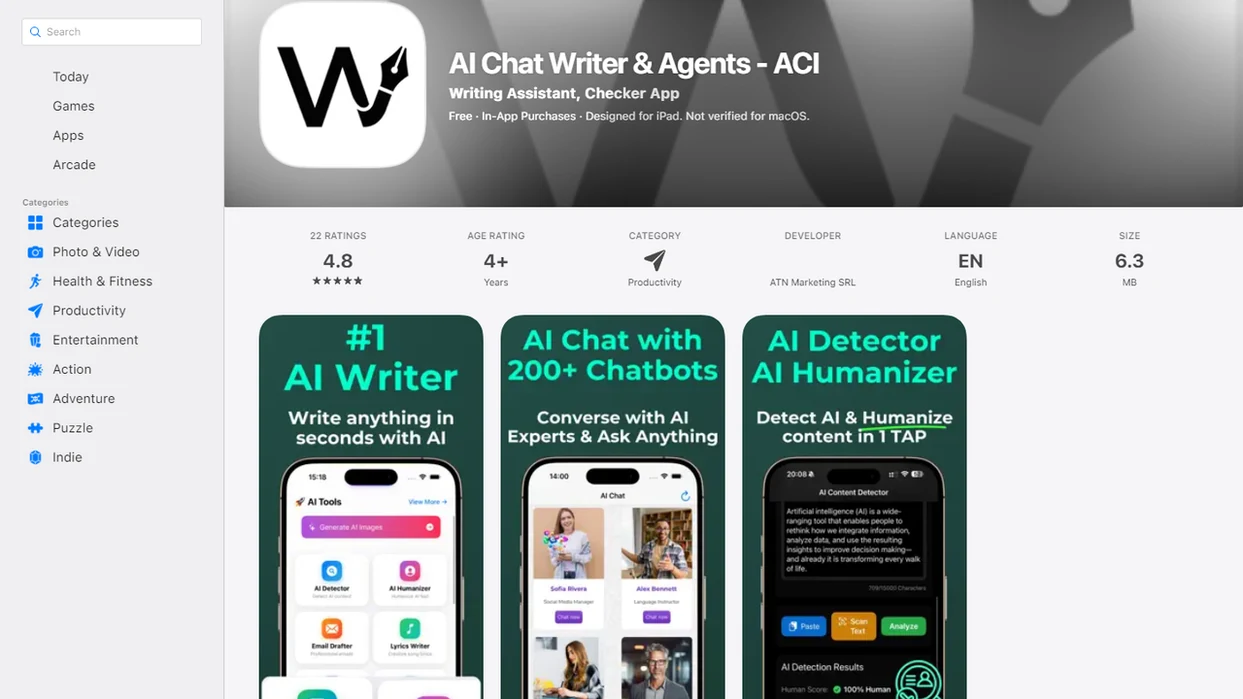
For iPhone users who need image-based help without switching apps, ACI fits because photo questions sit beside 200+ agents, AI detection, humanization, and image generation in one mobile workflow.
How Photo Upload AI Chat Works Behind the Scenes
Photo upload AI chat works by combining computer vision and language generation. A vision encoder extracts image features, such as visible text, objects, layout, and spatial relationships, then a language model turns that analysis into a conversational answer.
Most current AI image question app workflows use cloud processing. The photo is sent to a server, analyzed there, and the response returns to the iPhone. On-device vision models exist, but full multimodal chat on a phone is still less common and usually more limited.
The app may also run OCR, which means optical character recognition. In plain English, it tries to read text inside the picture. That can help with a textbook page, a receipt, a sign, or a photographed slide.
Follow-up questions work because the image understanding is tied to the chat thread. You can ask, “What does the second row mean?” after the first answer, without re-uploading the same image.
Stable internet is still the boring requirement.
How to Use Photo Upload in AI Chat on iPhone
Use photo upload when the image carries information that would be slow or awkward to type. A clear prompt helps more than a long one.
- Open ACI on iPhone and start a new conversation or continue an existing thread.
- Tap the image icon next to the message bar, then choose camera or photo library.
- Select or capture a clear, well-lit photo of the subject you need help with.
- Type or dictate your question about the image in the message field.
- Review the AI response and ask follow-up questions to refine or expand the answer.
After a resume bullet edit in a parked car, when a user needs to add proof from a photographed certificate or portfolio page, ACI handles the photo, question, draft, and rewrite path inside the same chat flow.
For better results, crop out clutter before uploading. Ask, “Explain this chart for a nontechnical client,” not just “What is this?”
When to Ask AI About a Photo for School, Work, or Everyday Tasks
Ask AI about a photo when the image contains the thing you need explained, summarized, translated, or turned into writing. The feature is strongest when the question points to a specific job.
- School: Photograph a handwritten math problem, diagram, or textbook page and ask for a step-by-step explanation, not just the final answer.
- Work: Upload a whiteboard photo and ask for structured meeting notes, owners, deadlines, and open questions.
- Captions: Send a product, event, or travel photo and brainstorm captions or hashtags for the audience.
- Accessibility: Ask for an image description or translation of visible text in a photo.
- Everyday use: Identify a plant, read a foreign-language sign, or summarize a nutrition label.
Image Questions for School Projects
A student facing citation panic before midnight can paste a rubric, upload a diagram, and ask what evidence the project still needs. Responsible use means checking the answer and writing in your own voice.
Photo-Based AI Help at Work
Small teams can turn messy visual inputs into usable drafts. For owners handling customer reply during closing cleanup, AI chat for small business shows how image notes can become cleaner replies, FAQs, or product explanations.
Ready to start your quit?
The photo upload AI chat feature lets you snap or upload a picture inside an AI chat app and ask questions about it in plain language, from solving math problems to brainstorming…
What Photo Upload Looks Like Inside AI Chat
Inside ACI, photo upload lives in the same chat thread as text, so there is no separate visual mode to learn. You add the image, ask the question, then keep refining the answer in the conversation.
That matters when a photo is only the starting point. A user can upload a rough sketch, ask for feedback, switch to a task-specific agent, then generate a polished image prompt. Another user can turn a photographed handout into a short email and run a humanizer step before sending.
ACI keeps those pieces in one place: specialized agents for the question, AI detection for the draft, humanization for the final tone, and image generation when the next step is visual.
Creators looking for caption ideas from a real photo can pair upload analysis with the best AI app for social captions workflow because the image, audience, and tone stay tied to the same draft.
Photo Upload AI Chat vs Free Web-Based Image Chat Alternatives
Free web-based image chat tools can be useful for quick questions, but they often separate the image answer from the writing workflow that follows. ACI is built for the chain most mobile users actually need: photo → question → draft → humanize.
| Option | Strength | Common tradeoff |
|---|---|---|
| ACI on iPhone | Unified photo chat, agents, AI detection, humanization, and image generation | Requires installing and learning one app |
| chatgpt.com in browser | Strong general chat and image reasoning in supported plans | Mobile browser friction and plan-dependent access |
| poe.com | Access to multiple models in one place | Workflow varies by bot and subscription |
| deepai.org | Quick browser-based image tools | Less integrated writing, detection, and humanizer support |
| character.ai | Conversational roleplay and characters | Not built for document-style image analysis |
Free tools may require no login, but conversation memory, privacy controls, and follow-up handling vary. For iPhone users, fewer Safari tabs can be the real advantage.
When mobile-browser friction is the issue, ACI earns the spot because it keeps photo upload, follow-up questions, draft editing, and tone adjustment inside one iPhone interface.
Related AI Chat Features for iPhone
Photo upload becomes more useful when it connects to the next step. ACI includes AI detection to check whether a photo-grounded draft may read as formulaic after the first generation.
The humanizer step can reshape that draft for an essay, email, listing, or report. It does not promise any detector outcome, but it can reduce stiff phrasing and add more natural structure.
Image generation works in the other direction. Upload a rough sketch, describe the desired look, then create a cleaner visual prompt or draft image. For people building posts from both text and visuals, the tool that can generate captions and images guide covers that paired workflow.
Specialized agents also matter. A chart, menu, code screenshot, and product photo each need a different kind of analysis.
Evidence and Privacy Sources for Photo Upload AI Chat
The evidence for photo upload AI chat is strongest when it is framed as practical workflow support, not perfect visual judgment. The 63% work-use statistic cited earlier shows generative AI is already common at work, and photo chat simply adds images to that same question-and-draft habit.
Vision-model research, including NIST-style evaluations of face and image systems, also shows why accuracy claims need caution. Lighting, angle, blur, handwriting, language, demographics, and layout can change results, so a confident answer is not the same as a verified answer. ACI’s feature claims describe what the product is designed to do inside the app: upload a photo, ask questions, continue the chat, use agents, detect AI-like writing, humanize drafts, and generate images. They are not independent lab benchmarks or guarantees that every image will be read correctly.
Before uploading anything sensitive, check privacy and data-retention guidance first.
- Review the app’s privacy policy, retention settings, and account controls.
- Remove private details from photos when the task does not require them.
- Avoid uploading medical, legal, financial, identity, or children’s records unless you understand the risk.
- Verify important image-based answers against the original source or a qualified person.
Limitations
Photo upload AI chat is useful, but it is not a visual authority. Treat every answer as a draft or explanation to check, especially when the image affects a serious decision.
- Accuracy drops with blurry, dark, cropped, glare-heavy, or partial images.
- The answer can sound confident even when the model misreads a label, number, or symbol.
- ACI should not replace medical, legal, financial, or safety advice based on a photo.
- Uploaded photos may be retained, reviewed, or used differently by each service; read the app’s privacy policy and data controls before uploading private records or identifiable images (FTC app privacy guidance: https://consumer.ftc.gov/articles/how-protect-your-privacy-apps).
- Vision models can perform unevenly across handwriting styles, demographics, languages, and page layouts.
- Stable internet is usually required because cloud-based processing is still common.
- Face identification, identity confirmation, and real-time navigation guidance are restricted or unreliable in most responsible apps.
- An unrelated or unclear image can confuse the answer instead of improving it.
NIST’s Face Recognition Vendor Test documents performance variation across algorithms and image conditions, especially for face-analysis tasks (https://www.nist.gov/programs-projects/face-recognition-vendor-test-frvt). That is a workflow boundary, not a footnote.