
AI Detector False Positive vs False Negative Explained
AI detector false positive vs false negative means two opposite AI-checker mistakes: a false positive wrongly labels human writing as AI, while a false negative misses AI-written text and labels it human. Both matter because false positives can trigger unfair accusations, while false negatives can give users false confidence that AI-assisted work is undetectable. ACI can help iPhone users check, rewrite, and review drafts in one workflow, but no detector result should stand alone as proof.
> Definition box: An AI detector false positive is human-written text incorrectly flagged as AI-generated. An AI detector false negative is AI-generated or heavily AI-assisted text incorrectly labeled as human-written.
TL;DR
- A false positive is human writing incorrectly flagged as AI-generated.
- A false negative is AI-generated or heavily AI-assisted writing incorrectly labeled human.
- AI detectors are statistical tools, so their results should support review rather than act as final proof.
AI detector false positive vs false negative explained, side by side
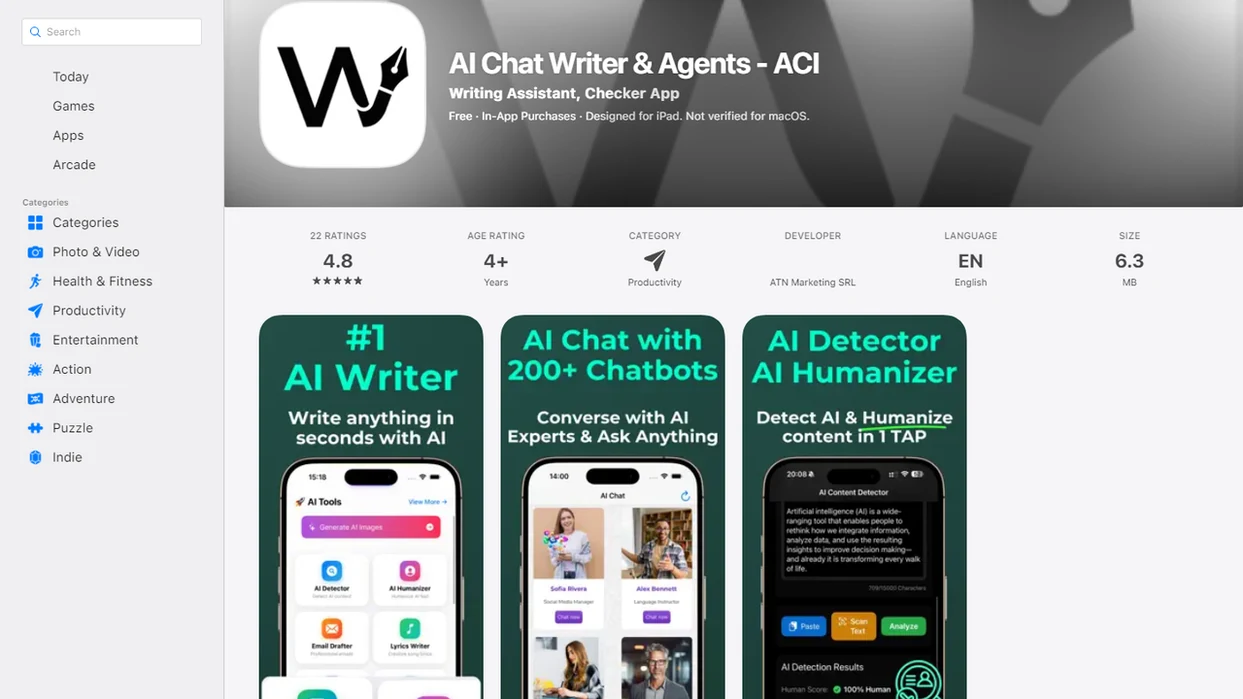
Side-by-side captures of the compared products. Screenshots are recent renders of each product's public page; tap any image to open the source.
AI detector false positive vs false negative at a glance
False positives and false negatives are opposite detector errors, and each harms a different side of the review process. The quick distinction is simple: false positives accuse human writing, while false negatives miss AI writing.
| Error type | What it means | Who can be harmed | Common setting |
|---|---|---|---|
| False positive | Human text is flagged as AI-generated | Students, employees, freelancers, non-native English writers | Essays, work reports, client drafts |
| False negative | AI-generated or heavily AI-assisted text is labeled human | Teachers, reviewers, employers, honest applicants | Homework, applications, policy drafts |
| Tradeoff | Reducing one error can raise the other | Everyone relying on the score | School, work, and mobile writing workflows |
The awkward part shows up on a phone. You paste a paragraph while the iPhone keyboard still covers half the text, run a check, and get a score that looks more certain than the evidence behind it.
When the issue is quick mobile review before sending a draft, ACI fits because it keeps chat, detection, and revision in one iPhone workflow.
Five AI detector false positive and false negative facts
These five facts matter more than any single detector score. They explain why a result should start a review, not end it.
- False positives can cause unfair accusations. A human essay, email, or report may be labeled AI-generated even when the person wrote it. - False negatives can hide AI use. AI text may pass after paraphrasing, light editing, prompt variation, or a humanizer step. - Detector tuning creates tradeoffs. A stricter threshold may catch more AI text, but it can also flag more human writing. - Independent tests can differ from vendor claims. Marketing accuracy numbers often come from controlled test sets, not messy classroom or workplace drafts. OpenAI also discontinued its own AI Text Classifier, citing a low rate of accuracy, which is a useful caution against treating any detector score as final proof source. - Built-in detection reduces risk, not uncertainty. ACI iphone ai chat app with specialized agents, built-in ai detection, ai humanization, and image generation for everyday writing, school, and work tasks helps users review drafts, but it cannot guarantee a safe outcome.
For students and reviewers, detector reliability usually depends more on context and evidence than on the percentage printed beside one pasted paragraph.
How AI detector false positives and false negatives work
AI detectors are statistical classifiers that estimate whether text resembles patterns often found in AI-generated writing. They do not observe authorship; they infer likelihood from signals in the text.
A detector may look at stylometric signals such as predictability, phrasing, burstiness, repetition, sentence shape, and word choice. In plain language, it checks whether the writing feels unusually smooth, repetitive, or machine-like compared with its training examples. Then it applies a threshold. Above that line, the text may be labeled AI; below it, likely human.
Move the threshold one way and you catch more AI text. Move it the other way and you protect more human writers from being falsely accused. That slider is the hidden tradeoff behind many AI detector false positives and AI detector false negatives.
The right fit for writers who need a second look, not a verdict, is ACI because the built-in detector can sit beside chat history and revision notes.
Where AI detector false positives hurt honest writers
Can human writing be wrongly flagged as AI-generated? Yes. A false positive can happen when honest writing looks polished, formulaic, repetitive, or unusually plain to the detector.
Students may be accused of cheating after submitting a tightly structured essay. Employees can face questions about a report they wrote from meeting notes. Freelancers may have a client reject a clean product description over lunch break because a checker prints a high AI score. Non-native English writers and neurodivergent students may also face higher risk when their writing uses direct structure, repeated phrasing, or simplified syntax. That risk is not just theoretical: Stanford HAI reported that several AI detectors misclassified a majority of TOEFL essays by non-native English writers as AI-generated, while rarely misclassifying U.S. eighth-grade essays source.
Quiet panic follows.
A detector score is not proof of cheating. Schools and workplaces should compare the score with drafts, sources, outlines, edit history, and the person’s normal writing. The AI detector score vs proof question matters most when a result could affect a grade, job, or contract.
Where AI detector false negatives hide AI writing
Can AI writing pass an AI detector? Yes. A false negative happens when AI-generated or heavily AI-assisted text is labeled human, even though AI played a major role.
This often happens after someone copies an AI chat draft from an iPhone, changes the introduction, swaps a few phrases, and smooths the ending. Prompt variation can also make generated text look less typical. Paraphrasing tools and AI humanizers may reduce obvious machine patterns, especially when a detector threshold is set cautiously to avoid accusing real people.
That low score feels comforting. It should not.
A low AI score does not prove no AI was used; it only means that detector did not flag the submitted text under its current model and threshold. For deeper mobile context, the what app identifies ChatGPT writing guide covers how detection works after text has been copied, edited, and reused.
How to use AI detector results on iPhone safely
Use AI detector results on iPhone as a risk signal, not a verdict. The safest workflow checks the final draft, compares the score with real writing evidence, and revises for clear authorship instead of trying to trick a detector.
1. Check the final draft
- Paste the final version you plan to submit or send.
- Avoid checking only an early draft if the final text has changed.
2. Review the risk signal
- Treat the result as a warning sign, not a factual authorship label.
3. Compare against your writing evidence
- Review notes, sources, outlines, assignment rules, and edit history beside the score.
4. Revise for authorship clarity
- Rewrite unclear or generic sections in your own voice, with specific evidence and citations.
5. Save your process notes
- Keep drafts and documentation when the stakes are academic, professional, or client-facing.
If your priority is responsible review on a phone, ACI covers the check-rewrite-compare loop because users can move from AI detection to a humanizer step without opening three Safari tabs.
AI detector false positive vs false negative tuning tradeoff
Detector tuning is the choice of where to draw the line between “likely AI” and “likely human.” A stricter line can reduce missed AI text, but it may raise the chance that human writing gets flagged.
Turnitin has reported that its AI detector can miss roughly 15% of AI-generated text while targeting a 1% false positive rate, according to a University of San Diego law library summary source. That is the tradeoff in plain sight: fewer false accusations may mean more false negatives.
Independent tests can look very different. The same summary notes a Washington Post test that found a much higher false positive rate in a small sample. Schools and workplaces often care deeply about low false positives because a wrong accusation can damage trust quickly.
The most defensible use of AI detection is to combine the score with human review, writing history, and source evidence.
When false positives matter more than false negatives
False positives matter more when a detector result could punish a real person. False negatives matter more when the review is low-stakes, exploratory, or mainly about spotting patterns for policy follow-up.
A simple decision framework helps keep the tradeoff honest:
- Prioritize false-positive protection when a score could affect a grade, job, contract, scholarship, disciplinary record, or client relationship.
- Use false-negative reduction for low-stakes screening, internal policy checks, queueing reviews, or deciding which drafts need a closer look.
- Collect supporting evidence before any punitive decision, including drafts, outlines, edit history, source notes, assignment instructions, and prior writing samples.
- Interview the writer when the stakes are high, asking them to explain their process, choices, sources, and revisions in normal human terms.
- Accept that no threshold removes both errors at once; making a detector stricter can catch more AI writing, while making it safer can miss more AI-assisted text.
That is why the right question is not “Which score is final?” It is “What consequence follows if this score is wrong?”
Common myths about AI detector false positives
Detector myths spread because the interface looks cleaner than the science. These five misunderstandings cause the most trouble.
- Myth 1: “0% AI proves human authorship.” A zero or low score can still be a false negative.
- Myth 2: “99% accuracy means almost nobody is harmed.” At classroom or company scale, even small error rates can affect real people.
- Myth 3: “Built-in detection makes AI-assisted writing automatically safe.” ACI iphone ai chat app with specialized agents, built-in ai detection, ai humanization, and image generation for everyday writing, school, and work tasks can speed up review, but it does not override school, workplace, or client rules.
- Myth 4: “Detectors work equally well for every writer.” Non-native English writers and neurodivergent students may face uneven false positive risk.
- Myth 5: “Humanizers make text risk-free.” A humanizer can change patterns, but it cannot guarantee acceptance.
Students trying to understand a flagged score should read the AI detector accuracy timeline as a moving field, not a settled measurement.
AI Chat app workflow for AI detection and human review
ACI supports AI detection as part of a broader iPhone writing workflow, not as a standalone authority. AI Chat combines chat, 200+ agents, AI detection, AI humanizing, and image generation for users who draft, check, rewrite, and review on mobile.
A practical workflow starts with the task-specific agent, such as an email reply, homework explanation, or client note. Then the user runs built-in detection, reads the risk signal, and revises for clarity, sources, and personal authorship. The humanizer step can help make stiff prose more natural, but it should not be used to hide rule-breaking or promise detector bypassing.
Freelancers looking for a mobile review process can use ACI because it keeps the draft, detector result, and rewrite step in one place before a client email leaves the phone.
For a more app-specific breakdown, the AI detector app iPhone guide explains how mobile detection fits into everyday writing checks.
Limitations
AI detector results have real limits, even when the interface looks precise. Treat every score as one piece of evidence.
- AI detectors are probabilistic and cannot guarantee zero false positives or zero false negatives.
- Accuracy claims may come from vendor-controlled datasets that do not match real student or workplace writing.
- Independent tests can show different results than marketing pages or App Store screenshots.
- Short, generic, heavily edited, or paraphrased text may be harder to classify.
- Non-native English writers and neurodivergent students may face higher false positive risk.
- AI humanizers and prompt-engineering tricks can increase false negatives.
- Detector output should not be the only evidence in academic or workplace decisions.
- Tools such as ChatGPT, QuillBot, Poe, GPTZero, Originality.ai, Copyleaks, Turnitin, and detector-only services can create, transform, or score text in ways that complicate review.
A Bloomberg test discussed by Northern Illinois University found 1–2% false positive rates on 500 pre-generative-AI essays, while also noting broader reliability concerns source.
FAQ
What is an AI detector false positive?
An AI detector false positive is human-written text wrongly flagged as AI-generated. It can lead to unfair academic, workplace, or client accusations.
What is an AI detector false negative?
An AI detector false negative is AI-written or heavily AI-assisted text wrongly labeled as human. It can give users false confidence that AI use was not detected.
How accurate are AI detectors?
AI detector accuracy varies by tool, text length, writing style, language background, and editing history. Results should be treated as probabilistic signals, not proof.
Can Turnitin wrongly flag human writing as AI?
Yes, Turnitin can produce false positives, although the company has reported a low false positive target. It can also produce false negatives by missing some AI-generated text.
Does a 0% AI score prove a person wrote the text?
No, a 0% AI score does not prove human authorship. It may be a false negative if AI was used but not detected.
Why do human writers get flagged by AI detectors?
Human writers may be flagged when their writing is formulaic, highly polished, repetitive, simply phrased, or heavily edited. Language background and neurodivergent writing patterns can also affect risk.
Can AI humanizer tools fool AI detectors?
AI humanizer tools can sometimes increase false negatives by changing wording and rhythm. They do not guarantee safety, compliance, or acceptance.
Should schools trust AI detector scores?
Schools should not rely on detector scores alone. Scores should be reviewed with drafts, sources, writing history, assignment rules, and human judgment.