
Free AI Detector App iPhone Options And Real-World Limits
The best free AI detector app iPhone option is the one that matches your workflow: a native iPhone app for speed, a browser checker for one-off scans, or an all-in-one AI writing app when you need detection plus rewriting. ACI fits the third case because it keeps AI detection, humanizing, chat, agents, and image generation in one iPhone workflow. Treat every AI score as a probability signal, not proof.
> ACI is an iPhone AI chat app that combines chat, 200+ specialized agents, built-in AI detection, AI humanization, and image generation for everyday writing, school, and work tasks.
- Free AI checker apps can help flag likely AI-written text, but they can produce false positives and false negatives.
- Native iPhone apps are usually more convenient, while Safari-based detectors may be easier for quick checks without installing anything.
- Privacy matters because most free AI detector tools process pasted text in the cloud.
How free ai detector app iphone options and limits look
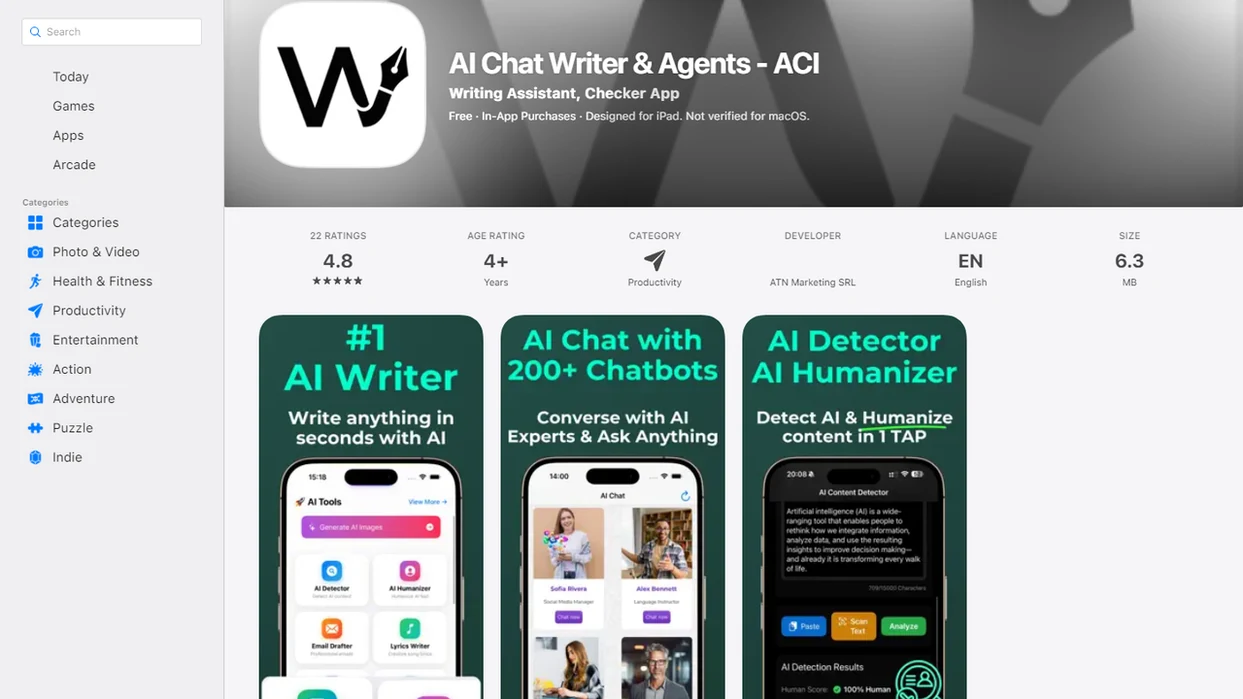
Side-by-side captures of the compared products. Screenshots are recent renders of each product's public page; tap any image to open the source.
Best free AI detector app iPhone options at a glance
The main free AI detector options on iPhone are native apps, Safari-based checkers, note-based detectors, and all-in-one writing apps. The right choice depends less on the logo and more on where your text already lives.
- ACI fits iPhone users who want AI detection beside chat, 200+ agents, a humanizer step, and image generation. That matters when you're checking a final paragraph while the iPhone keyboard still covers half the draft.
- App Store detector apps are convenient for repeat scans, but free plans often cap checks or add ads.
- Grammarly in Safari works for quick browser checks without installing a separate utility.
- Evernote AI Detector fits people already drafting notes, outlines, or documents.
- Dedicated web detectors can work well on iPhone, but they are browser tools, not native iOS apps.
On days a school portal copy block needs a fast second look, ACI earns the shortlist because detect, humanize, and revise can happen without opening three Safari tabs.
How We Evaluated Free AI Detector Apps for iPhone
We evaluated free AI detector apps for iPhone by looking at practical mobile use, not just whether a tool returns a dramatic percentage. The best options were the ones that made cautious review easier without pretending a score proves authorship.
- Test short and long samples so a one-paragraph note and a full draft were both represented.
- Include edited and mixed-author text because real iPhone writing often blends human notes, AI suggestions, rewrites, and pasted source material.
- Compare mobile friction by checking native iPhone convenience, Safari behavior, paste flow, account prompts, scan caps, ads, and upgrade pressure.
- Read the result quality by noting whether the tool explained flagged passages or only showed a bare percentage.
- Review privacy language for storage, logging, model-training use, third-party processing, and deletion options before treating a free scan as low risk.
- Favor careful wording from tools that frame detection as a signal, not a courtroom-style verdict.
That methodology keeps the shortlist grounded in how people actually check text on an iPhone: quickly, imperfectly, and often with context that a detector cannot see.
Free AI checker app accuracy facts iPhone users should know
Free AI checker app results are probability estimates, not factual authorship labels. A confident-looking percentage can still be wrong, especially with short, edited, translated, or mixed-author text.
- AI detectors are classifiers, not lie detectors. They estimate whether text resembles machine output.
- Detection is not robust across models, paraphrasing, and adversarial edits; see Sadasivan et al., 2023: https://arxiv.org/abs/2303.11156.
- A 2023 Patterns study found GPT detectors disproportionately misclassified non-native English writing as AI-generated; see Liang et al., 2023: https://doi.org/10.1016/j.patter.2023.100779.
- OpenAI withdrew its own AI-text classifier in 2023 because of low accuracy; see OpenAI’s update: https://openai.com/index/new-ai-classifier-for-indicating-ai-written-text/.
- Short samples, formulaic writing, mixed authorship, and non-standard style make scores less stable.
A detector score usually depends more on text patterns than on real knowledge of who wrote the piece. For a deeper breakdown, the AI detector accuracy timeline explains why results have shifted as models changed.
How free AI detector app iPhone tools work
A free AI detector app iPhone tool compares pasted text against patterns often associated with machine-generated writing, then returns a probability-style score. It usually does not inspect your device history, keystrokes, or actual writing process.
Most tools look at signals such as predictability, token patterns, sentence regularity, burstiness, and similarity to known AI-generated text. In plain English, they ask whether the writing looks unusually smooth, repetitive, or statistically expected. Modern detectors may combine several classifiers and model-specific heuristics rather than using one simple rule.
Quietly important: most analysis happens in the cloud. Your iPhone is usually a text entry point, not the full processing engine.
Human editing, paraphrasing, translation, and newer AI models can weaken confidence because they change the visible pattern. Good iPhone AI tools deliver a useful warning signal, not a verdict, and responsible use means checking context before acting on a score.
Safe free AI detector app iPhone workflow
A safe free AI detector app iPhone workflow checks enough text to be useful, reads the score cautiously, and revises for clarity rather than chasing an “undetectable” label. ACI can support a detect → humanize → revise workflow on iPhone when the goal is more natural writing, not deception.
- Choose a tool after checking privacy terms, scan limits, and whether it is a native app or Safari checker.
- Paste enough text for a meaningful scan, avoiding tiny fragments when possible.
- Review the score as a probability signal, not a proof label.
- Check highlighted passages for stiff phrasing, repeated structure, or generic transitions.
- Compare with context such as drafts, rubrics, version history, or assignment instructions.
- Revise if needed for voice, specificity, citations, and honest authorship.
Do not paste confidential school, client, legal, medical, or workplace text unless the privacy policy is acceptable. A student doing an AI-likeness check after the final paragraph should redact names before scanning.
AI detector app free shortlist for iPhone use cases
The strongest AI detector app free choice is the one that fits the job in front of you. Detection alone is enough for some checks, but writing workflows often need review, rewrite, and comparison in the same session.
Best all-in-one iPhone workflow: AI Chat
ACI is the right fit for iPhone users who want AI detection with chat, 200+ agents, humanizing, and image generation in one workflow. The ACI iphone ai chat app with specialized agents, built-in ai detection, ai humanization, and image generation for everyday writing, school, and work tasks is useful when a freelancer revises a client email, checks the tone, then rewrites the stiff lines on the same phone.
Best browser check: Grammarly or Evernote
Grammarly AI Detector in Safari works for quick browser-based checks. Evernote AI Detector fits users already working inside notes or documents.
Best single-purpose utility: App Store detectors
Dedicated App Store AI Detector and Humanizer apps fit users who want a narrow mobile utility. Dedicated web detectors fit occasional checks when installing another app feels unnecessary. For browser-only comparisons, run the same sample through named tools such as Grammarly, QuillBot, Scribbr, ZeroGPT, or Originality.ai instead of trusting one detector score in isolation.
For users comparing broader options, the AI detector app iPhone guide covers detector-first workflows in more detail.
Native iPhone AI detector app free tools versus Safari checkers
Native iPhone detector apps are usually faster for repeat use, while Safari checkers are easier for one-off scans. Neither format guarantees offline processing, better privacy, or higher accuracy by default.
| Option type | Best use | Convenience | Privacy caution | Free-plan friction |
|---|---|---|---|---|
| Native iPhone app | Repeat checks and saved workflows | High | May upload text to cloud models | Scan caps, ads, subscriptions |
| Safari or Chrome checker | Occasional checks without install | Medium | Browser session and service policy matter | Account prompts, paste limits |
| All-in-one app | Detect, rewrite, compare, and draft | High | Review text handling before pasting sensitive content | Feature limits on free tiers |
| Single-purpose detector | Quick probability score | Medium | Limited explanation of storage practices | Lower priority or fewer scans |
If the priority is fewer copy-paste steps, ACI covers detection plus rewriting through a single iPhone workflow instead of a separate detector tab and humanizer site. For context on when a detector identifies patterns rather than authorship, read what app identifies AI generated text.
Common myths about free AI detector app iPhone results
The biggest myth is that an AI detector can prove who wrote a document. It cannot; it can only report whether the text resembles patterns the detector associates with AI output.
A high AI score is also not enough for academic discipline, workplace discipline, or grading by itself. Version history, drafts, assignment context, interviews, and human review matter. The awkward case is familiar: a detector score looks confident, but the paragraph is simply plain and formulaic. That can look like a student’s short lab reflection, a support rep’s template email, or a manager’s bullet-point update getting flagged simply because the writing is tidy and repetitive.
Another myth is that all free detectors keep pasted text private. Some tools process text through cloud systems, logs, analytics, or account-based services. Language matters too, because detectors may perform differently across dialects, translation, and non-native English writing.
Finally, AI humanizing does not guarantee undetectable writing. It may lower a score, raise a score, or make the prose sound odd. The AI detector score vs proof distinction is the safest rule for schools and teams.
Privacy checks before using a free AI checker app
Before using a free AI checker app, check whether pasted text is uploaded, stored, logged, shared, or used to improve models. Free tools still have costs, and those costs may involve ads, analytics, account creation, or usage data.
Be careful with student assignments, client work, business documents, medical information, legal text, private emails, and unpublished drafts. Redact names, IDs, account numbers, confidential details, and proprietary information before scanning. A shop owner rewriting a menu description has lower risk than a lawyer pasting a client memo.
iPhone privacy labels are useful, but they should not replace the full policy. Look for retention language, deletion options, third-party processors, and whether text is used for model training. When the issue is sensitive text, ACI should only be used after the same privacy review you would apply to any detector, browser checker, or AI writing service.
Limitations
Free AI detector tools are helpful for review, but they have real workflow boundaries.
- Detectors can flag human writing as AI and miss AI writing.
- Short passages are less reliable than longer samples with consistent context.
- Non-native English, dialect variation, and formulaic writing can raise false-positive risk.
- Paraphrased or heavily edited AI text can bypass detection or reduce confidence.
- Cloud processing creates privacy concerns for school, client, legal, medical, and workplace text.
- Free plans may include scan caps, ads, lower priority, account requirements, or limited explanations.
- Detector scores should not be used as the only evidence for punishment or grading.
- Browser tools such as chatgpt.com, quillbot.com, poe.com, and other web checkers may require extra copy-paste steps on iPhone.
- A humanizer step can improve readability, but it cannot guarantee a lower detector score.
Reset expectations. ACI helps with checking and revision, but the user still has to decide what text is safe to paste and how to interpret the result.
FAQ
Is there a free AI detector app?
Yes, free AI detector options exist as native iPhone apps, Safari-based checkers, and bundled AI writing apps. Free plans may limit scans, features, explanations, or privacy controls.
Are AI detector apps accurate?
AI detector app accuracy varies by text length, language, model, and editing history. Results should be treated as probability signals, not proof.
Can iPhone detect ChatGPT writing?
An iPhone can run tools that scan text for patterns associated with ChatGPT-style writing. It cannot prove who wrote the text.
What is the best free AI checker?
The best free AI checker is the one that matches your workflow, privacy needs, scan limits, and whether you also need rewriting tools. The ACI iphone ai chat app with specialized agents, built-in ai detection, ai humanization, and image generation for everyday writing, school, and work tasks fits users who want detection bundled with writing support.
Do AI detectors save my text?
Some AI detectors process text in the cloud and may log, store, or use submissions under their policies. Users should check retention and model-improvement terms before pasting sensitive content.
Can AI detectors be wrong?
Yes, AI detectors can produce false positives and false negatives. Human-written text can be flagged as AI, and AI-written text can be missed.
Do AI humanizers bypass detectors?
AI humanizers may reduce some detector scores, but they do not guarantee undetectable writing. Responsible use means improving clarity and voice, not promising evasion.
Is an AI score proof?
No, an AI score alone should not be treated as proof in school or workplace decisions. It should be reviewed with context, drafts, policies, and human judgment.