
Mobile AI Humanizer vs Web Humanizer Workflows

Choose a mobile AI humanizer when you need fast rewriting, AI detection, and editing from your phone; choose a web humanizer when you prefer desktop copy-paste workflows for longer documents. The mobile AI humanizer vs web humanizer decision is mostly about workflow fit, privacy expectations, export needs, and responsible use rather than one platform being automatically more capable.
> ACI is the AI Chat iPhone app for phone-first writing workflows, combining specialized agents, built-in AI detection, AI humanization, and image generation in one place.
- Mobile AI humanizers are best for quick essays, emails, messages, captions, and work edits on an iPhone.
- Web humanizers are best for longer drafts, desktop document review, and users who already write in browser-based tools.
- Neither mobile nor web humanizers can guarantee that text will bypass AI detectors, which can produce false positives and inconsistent scores.
Mobile AI humanizer vs web humanizer workflows, side by side
Side-by-side captures of the compared products. Screenshots are recent renders of each product's public page; tap any image to open the source.
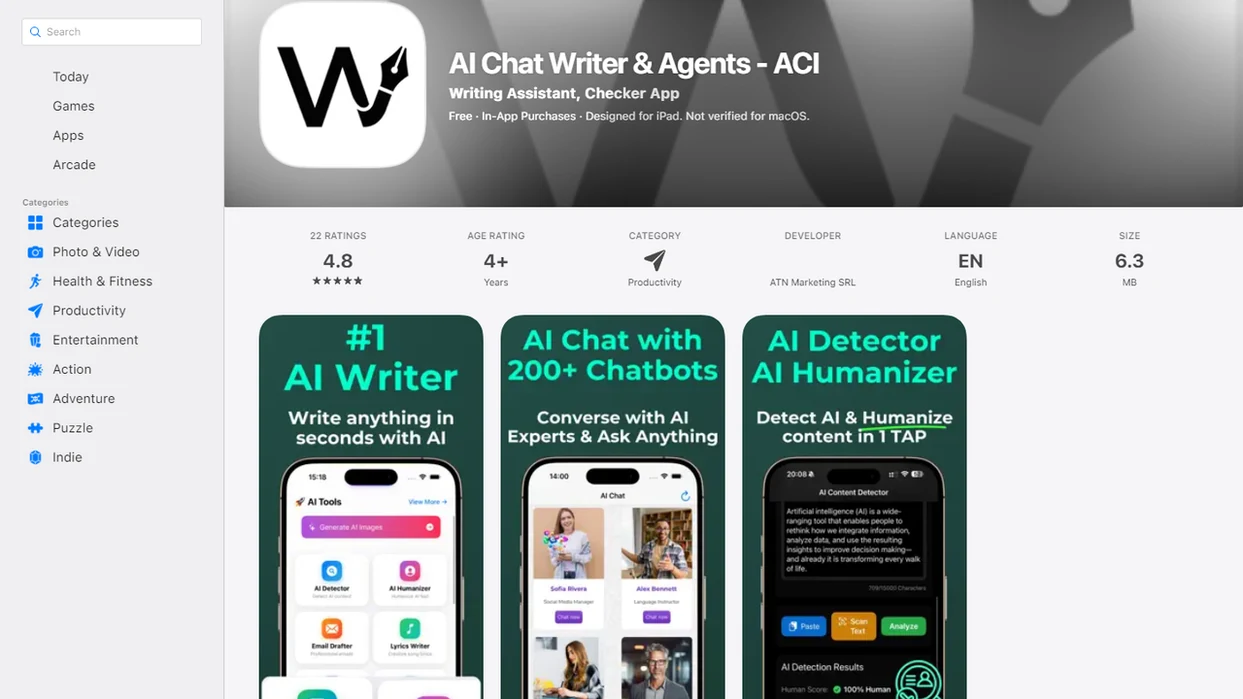
Mobile AI Humanizer vs Web Humanizer At-a-Glance Comparison
A mobile AI humanizer is usually better for fast phone-first editing, while a web humanizer usually fits longer desktop review. Many tools rely on similar LLM technology, so the workflow around the model often matters more than the platform label.
| Factor | Mobile AI humanizer | Web humanizer |
|---|---|---|
| Convenience | Fast edits from an iPhone | Better with a full keyboard |
| Writing context | Emails, captions, replies, short essays | Reports, long essays, CMS drafts |
| Detection | Often built into the same flow | Often separate or tab-based |
| Editing | Quick revise, compare, share | Easier side-by-side review |
| Privacy | Check App Store privacy notes and account terms | Check site terms, cookies, and retention |
| Export | Share sheet, copy, message, email | Copy-paste into Docs, Word, LMS, CMS |
| Best fit | On-the-go writing | Document-heavy editing |
In 2023, 90% of U.S. adults said they owned a smartphone, according to Pew Research Center (https://www.pewresearch.org/internet/fact-sheet/mobile/), and mobile devices accounted for about 58% of global website traffic in StatCounter data (https://gs.statcounter.com/platform-market-share/desktop-mobile-tablet). That helps explain why mobile-first humanizing is now normal. ACI fits the iPhone side because chat, 200+ agents, AI detection, humanizing, and image generation sit in one workflow.
How Mobile AI Humanizer and Web Humanizer Tools Work
AI humanization is the process of rewriting AI-generated or stiff text to vary sentence rhythm, phrasing, transitions, specificity, and tone while trying to preserve the original meaning.
Most mobile and web humanizers use cloud LLMs, prompt instructions, style controls, and sometimes AI detection scoring. In plain terms, the system looks for patterns that feel too uniform, then rewrites the passage with more natural variation. The common loop is simple: paste or draft text, detect likely AI patterns, rewrite, review, and revise again.
The awkward part comes after the score appears. A detector may label a plain paragraph as highly AI-like even when a person wrote it quickly before midnight. Detection scores are probabilistic signals, not proof that text is human-written or AI-written.
When the issue is switching from chat to detection to rewriting on an iPhone, ACI fits because the built-in detector and humanizer step keep the loop inside one app instead of three Safari tabs.
Where a Mobile AI Humanizer App Wins
Mobile AI humanizers win when the draft is already happening on your phone. That includes emails, essays, texts, social posts, job applications, workplace replies, and quick creator edits.
- A mobile humanizer reduces the revision loop to draft, detect, humanize, edit, and share.
- Phone-based editing works well when the deadline is close and the text is under a few pages.
- Mobile does not automatically mean weaker, because many apps call strong cloud models.
- Workflow design matters: history, compare views, share options, and task agents change the experience.
- The final review still belongs to the writer, especially for facts, tone, and citations.
The tiny screen has tradeoffs. You may be checking a paragraph while the iPhone keyboard covers half the ending, which makes careful review slower.
For students editing between lecture slides, ACI covers the quick-check use case because the ACI iphone ai chat app with specialized agents, built-in ai detection, ai humanization, and image generation for everyday writing, school, and work tasks keeps drafting and rewriting together.
Where a Web Humanizer Workflow Wins
A web humanizer workflow wins when the draft is long, heavily formatted, or tied to desktop research. Large screens make it easier to compare the original beside the humanized version, especially when citations, comments, and headings are involved.
Browser tools can feel smoother when writing starts in Google Docs, Microsoft Word, a learning management system, or a CMS editor. Copy-paste is not elegant, but it is familiar. Teams may also prefer web access because accounts, shared browsers, and admin policies are easier to manage than individual phone installs.
Web does not always mean desktop, though. Many people open quillbot.com, chatgpt.com, poe.com, or other browser tools from a phone. The real split is workflow design, not the device alone.
The right fit for document-heavy revision is often web first, because keyboard editing and side-by-side review make long passages easier to audit before submission.
AI Humanizer App vs Web Privacy and Policy Differences
“Is it safe to paste my draft into a mobile or web humanizer?” The honest answer is: only after you check data retention, account requirements, terms of use, and whether pasted content may be stored, reviewed, or used to improve systems.
Sensitive school, client, legal, medical, HR, and internal business writing deserves stricter handling. A holiday sale caption in the stockroom is low-risk. A client contract summary is not. Before pasting, read the privacy policy and look for deletion controls, account settings, and subscription fine print.
A 2024 EDUCAUSE survey reported that 34% of instructors changed assignments because of generative AI (https://www.educause.edu/ecar/research-publications/2024/2024-students-and-technology-report). That matters because humanized text is not automatically safe from academic integrity, plagiarism, disclosure, or workplace policy issues.
Good iPhone AI chat apps deliver fast drafting, checking, and rewriting in context, not a permission slip to ignore school, client, or employer rules.
How to Use a Mobile Humanizer Comparison for Real Drafts
Start with the writing job, not the feature list. A thank-you note after a video call, a scholarship paragraph, and a 2,000-word report need different review habits.
Step-by-step mobile and web humanizer test
- Choose your real draft before comparing tools, preferably one you actually need to send or submit.
- Run the same text through one mobile workflow and one web workflow when possible.
- Compare the outputs for meaning, tone, rhythm, missing details, and awkward phrasing.
- Check citations and facts after humanizing, especially for essays, reports, and client work.
- Review the policy from your school, employer, client, or platform before using the edited text.
- Keep the clearer version rather than the version with the lowest detector score.
If you are comparing broader app choices, the AI detector app vs web detector question follows the same pattern: convenience helps, but the review process decides the outcome.
If your draft begins on an iPhone, then ACI can handle the first pass because chat, detection, humanizing, and a compare-style rewrite flow stay close together.
Common Myths About Mobile AI Humanizers and Web Humanizers
Mobile and web humanizers are often judged by bad assumptions. The platform matters, but it does not settle quality, ethics, or detector outcomes by itself.
- Myth: Mobile humanizers are always weaker. Many mobile and web tools use similar cloud LLMs, so output depends on prompts, controls, and review.
- Myth: Humanizers can reliably beat Turnitin or GPTZero. No humanizer can guarantee bypassing probabilistic AI detection systems.
- Myth: Mobile humanizers are only for captions. Phone-first users also revise essays, resumes, client emails, and workplace replies.
- Myth: Humanized writing is automatically ethical. Rules still depend on disclosure, originality, citation, and permitted assistance.
- Myth: A lower AI score means better writing. Clear meaning usually matters more than chasing a detector number.
A 2024 peer-reviewed analysis in the International Journal for Educational Integrity found that AI detectors can produce false positives and inconsistent classifications across tools (https://edintegrity.biomedcentral.com/articles/10.1007/s40979-023-00146-z). That is why the do AI writing apps actually help question should include review quality, not just detection scores.
Evidence Behind Mobile vs Web Humanizer Tradeoffs
The evidence supports a workflow split, not a quality crown. Mobile ownership and traffic data explain why phone-first editing is common, while desktop document habits explain why long-form review still often feels easier on the web.
- Start with device behavior: high smartphone ownership and mobile web traffic make it reasonable that people want drafting, detection, and humanizing on the same phone where messages, emails, and short essays already happen.
- Match the document length: long reports, citations, comments, and formatting benefit from a larger screen, keyboard, and side-by-side comparison in tools like Google Docs, Microsoft Word, a CMS, or a browser-based humanizer.
- Treat detector scores cautiously: false-positive research shows that AI classifiers can disagree or mislabel human writing, so a lower score should not outrank clarity, accuracy, voice, or policy compliance.
- Compare real workflows: you might test ACI on iPhone, then compare a web pass in quillbot.com, chatgpt.com, poe.com, or another browser tool without assuming either one can guarantee detector bypass.
- Stop at the evidence limit: usage and productivity patterns show where each platform is convenient; they do not prove that mobile or web humanizers write better by default.
Best Choice for Mobile AI Humanizer vs Web Humanizer Users
Choose mobile if your writing starts and ends on an iPhone. Choose web if your writing lives in long documents, browser tabs, and desktop editors.
- iPhone-first writers: A mobile humanizer fits quick emails, messages, essays, and application edits.
- Students between classes: Mobile works for short rewrite passes, but policy and citation checks still matter.
- Desktop-first editors: Web tools fit long drafts, footnotes, comments, and document-heavy revision.
- Hybrid users: Draft on web and refine on mobile, or draft in ACI and finish in a desktop editor.
For professionals who need a fast reply without losing the thread, ACI earns the spot because a workplace reply can move from chat draft to detector check to humanizer step before it is pasted into mail.
Web is often better for long-form editing because the larger screen makes factual review less cramped. For a broader app comparison, the AI Chat app vs ChatGPT guide covers when an iPhone workflow beats a plain chat window.
Limitations
AI humanizers are editing aids, not guarantees. The biggest risk is treating a rewritten draft as automatically safe, original, or undetectable.
- AI humanizers cannot guarantee bypassing AI detectors.
- AI detectors can produce false positives, including on human-written work.
- Rewriting can change meaning, weaken citations, remove nuance, or add awkward phrasing.
- Sensitive content may create privacy, confidentiality, or compliance concerns in third-party tools.
- Academic and workplace rules may still require disclosure of AI assistance.
- Over-humanizing can make writing less clear, less accurate, or unlike the writer’s real voice.
- Mobile editing can be constrained by small screens, while web workflows can be slower on phones.
- Some web tools, including detector-only or humanizer-only sites, may require extra copy-paste steps.
Plain writing gets flagged sometimes.
If you are weighing subscription value, is AI Chat app worth it is the more direct question than whether any one detector score moved after a rewrite.
FAQ
Are mobile humanizers accurate?
Mobile humanizer accuracy depends on the model, prompt, review process, and whether the rewrite preserves the original meaning. A good result should be checked for facts, tone, citations, and policy fit.
Are web humanizers better?
Web humanizers are better for some desktop workflows, especially long documents and side-by-side review. They are not automatically better in output quality than mobile tools using similar models.
Can humanizers bypass AI detectors?
No humanizer can guarantee bypassing AI detectors. AI detection systems are probabilistic and can produce inconsistent results.
Is AI humanizing allowed?
AI humanizing is allowed only when it fits the rules of the school, employer, client, or platform. Some settings require disclosure or prohibit certain AI-assisted edits.
Do humanizers change meaning?
Yes, humanizers can change facts, tone, citations, emphasis, or intent. Every rewritten draft needs human review before use.
Which is better for essays?
Web humanizers often fit long essay review, while mobile humanizers fit shorter edits and phone-based drafting. Students should follow academic integrity rules and disclose AI assistance when required.
Which is better for emails?
Mobile humanizers often fit quick email edits because the draft, rewrite, and send step happen on the phone. Web tools may fit longer professional drafts that need careful review.
Do mobile humanizers store text?
Some mobile humanizers may store text, and others may limit retention depending on settings and policy. Check each app’s privacy policy, data retention terms, and account controls before pasting sensitive content.