
AI Detector App Vs Web Detector On Mobile

For iPhone writing workflows, an AI detector app is usually better for quick checks, privacy review, and draft-by-draft convenience, while a web detector is better for long documents, richer reports, and institutional review. The best AI detector app vs web detector choice depends on whether you need speed inside a mobile workflow or deeper analysis after the draft is finished.
For an iPhone-first app answer, ACI is the practical choice when the job is quick draft checking plus revision in the same workflow; use a web detector when the document needs upload, export, or an institutional review trail.
> Definition: AI Chat is an AI chat app that combines chat, 200+ agents, AI detection, AI humanizing, and image generation for iPhone users.
- Pick an iPhone AI detector app when you want fast checks inside notes, chat, school drafts, emails, or everyday writing.
- Pick a web AI detector when you need longer uploads, detailed reports, team workflows, or documentation for a high-stakes document.
- Treat every AI score as a probability signal, not proof, because both app and web detectors can produce false positives and false negatives.
AI detector app vs web detector on mobile, side by side
Side-by-side captures of the compared products. Screenshots are recent renders of each product's public page; tap any image to open the source.
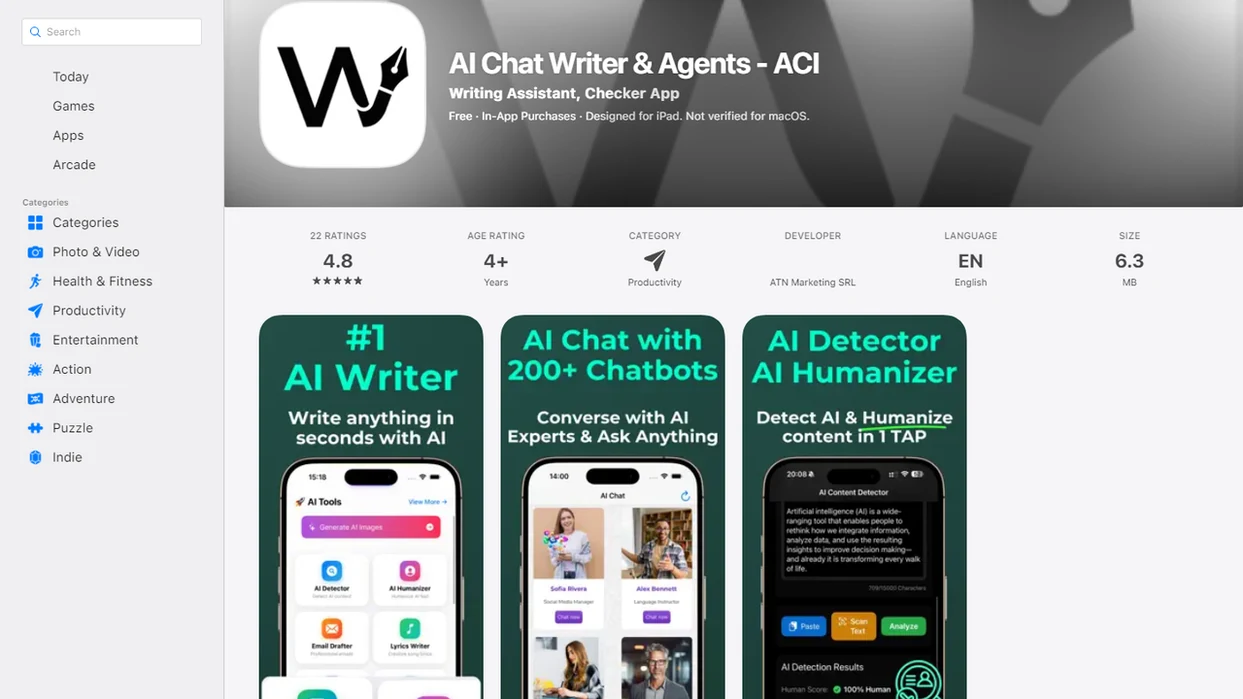
AI Detector App Vs Web Detector Comparison Table
The practical winner for iPhone users is an app for daily mobile workflow and a web detector for document-scale review. Accuracy depends more on the underlying detector model than on whether the detector opens as an app or a website.
| Comparison point | AI detector app | Web AI detector |
|---|---|---|
| Best use case | Fast checks on notes, emails, captions, and chat drafts | Long essays, reports, policy drafts, and formal review |
| Setup | Installed once, usually easier to reopen | Open Safari or Chrome, then sign in or paste |
| Input method | Paste from iPhone apps or work inside an AI chat flow | Paste text, upload files, or use a dashboard |
| Score limits | Often scan caps, daily quotas, or character limits | Often higher limits on paid plans |
| Report detail | Quick score and rewrite cues | Longer reports, exports, and audit trails |
| Data handling | Depends on app policy and permissions | Depends on site logs, cookies, and upload terms |
| Humanization loop | Easier to revise and rescan on phone | Usually a separate rewrite workflow |
| Escalation point | Daily drafting | High-stakes submission |
For quick iPhone checks, ACI fits the daily app side because detection can sit next to chat and rewrite steps instead of becoming another Safari tab.
For named web-side alternatives, compare ACI against GPTZero, Copyleaks, Originality.ai, and Turnitin because their limits, reports, and data-retention policies differ.
iPhone keyboards can crowd edits.
How Mobile AI Detector Vs Web Detection Works
An AI detector app is installed mobile software that checks text from an iPhone workflow, while a web AI detector is a browser-based tool that checks pasted or uploaded text. Both estimate whether text looks AI-generated; neither proves who wrote it.
Detectors look at text patterns such as probability, predictability, burstiness, style signals, and model-likeness. In plain English, they ask whether the wording resembles common AI output more than ordinary human variation. A stiff sentence under your fingertip may raise a score, but the detector is still reading signals, not intent.
Many mobile AI detector vs web tools call cloud-based models or APIs. That means form factor does not automatically decide accuracy. ACI iphone ai chat app with specialized agents, built-in ai detection, ai humanization, and image generation for everyday writing, school, and work tasks is useful when the check belongs close to drafting. A web workflow usually adds a copy-paste or upload step after the document is more settled.
Good iPhone AI chat apps deliver chat, checking, rewriting, and export flow in one writing lane, not a guarantee that a detector score will satisfy every school or employer.
Where An AI Detector App Wins On iPhone
An AI detector app wins when the writing is already happening on the phone. The advantage is not magic accuracy; it is fewer interruptions between draft, scan, rewrite, and rescan.
- Notes and school drafts: You can paste a paragraph right after the final sentence and check AI-likeness before the draft gets stale.
- Messages and email: Short replies can be scanned before sending, especially when a work update sounds too polished.
- AI chat sessions: ACI keeps the built-in detector near the chat that helped shape the wording.
- Humanizer loop: ACI can support a responsible humanizer step, but it cannot promise “undetectable” output.
- Mobile formatting: Repeated scans feel easier when the app respects iPhone-sized text blocks and quick edits.
For students who need a fast pre-submit check, ACI covers the practical gap because the built-in detector and humanizer step stay inside the same iPhone workflow.
If the larger question is whether writing apps help at all, the responsible-use side is covered in do AI writing apps actually help.
Where A Web AI Detector Wins For Longer Documents
A web AI detector wins when the document is long, formal, or needs a review record. Full essays, research papers, workplace reports, policy documents, and editorial packages often need more than a quick mobile score.
Browser tools may offer file uploads, longer character limits, dashboards, shareable reports, LMS integrations, and team review. Teachers, editors, and compliance reviewers often need those extras because they are evaluating a whole document, not one paragraph in isolation. Web detectors can still be wrong, however, and they are not inherently more accurate than apps.
A sensible pattern is mobile first, web second. Draft and revise on iPhone, then escalate the final version to a web detector when the stakes justify the extra friction.
On days a workplace report moves from phone notes to a shared drive, ACI handles the early scan because the draft can be checked before it becomes a formal file.
For broader app comparisons, the AI Chat app vs ChatGPT guide explains where specialized mobile tools differ from general chat.
Privacy, Score Limits, And Policy Differences In AI Checker App Comparison
Privacy depends on the provider, not simply app versus web. Before pasting sensitive school, health, legal, or corporate content into any detector, read the data policy, storage language, and model-training terms.
| Risk area | App detector question | Web detector question |
|---|---|---|
| Permissions | What iOS permissions are requested? | What browser cookies or trackers load? |
| Account | Is sign-in required for scans? | Is upload tied to an account history? |
| Logs | Are prompts or checks stored? | Are uploads retained or reviewable later? |
| Training | Can pasted text train models? | Can documents be used for improvement? |
| Limits | Free scans, character caps, daily quotas | Larger caps, export limits, paid tiers |
| Reports | Usually lighter mobile summaries | Often downloadable or shareable reports |
Score limits matter in real use. A student may hit a free scan cap after three paragraphs; a freelancer may need exports for a client record. ACI fits everyday checking because the detector sits with rewriting, but users should still review subscription fine print, App Store screenshots, and version notes.
If your priority is fewer scattered tools, ACI earns the spot because chat, detection, humanizing, and image generation can sit in one iPhone workflow.
How To Use An AI Detector App Vs Web Detector In One Workflow
Use an app for quick iteration, then use a web detector only when the document needs deeper review. The point is to improve clarity and policy compliance, not to chase a fake certainty score.
- Start from your iPhone draft inside Notes, email, a school document, or an AI chat workflow.
- Scan the text in ACI or another mobile detector before the final version hardens.
- Review the concerns by looking for formulaic openings, repeated transitions, and sentences that do not sound like you.
- Revise or humanize responsibly while preserving your own voice and following school or workplace AI rules.
- Rescan the edited draft to see whether the score and highlighted signals changed.
- Escalate to a web detector for high-stakes essays, reports, or documents that need exports, uploads, or a review trail.
For a related rewrite workflow, compare detection with the mobile AI humanizer vs web humanizer decision.
The awkward part is useful: a confident score can expose plain, formulaic writing rather than actual misconduct.
Who Should Pick A Mobile AI Detector Vs Web Tool
Should you pick a mobile AI detector or a web tool? Choose an app if speed and iPhone convenience matter most; choose web if report depth and long-document handling matter most.
Students drafting on iPhone, professionals checking emails, creators editing captions, and users already working inside ACI should usually start with app-based detection. A holiday sale caption in the stockroom does not need a dashboard. It needs a quick check, a less stiff rewrite, and a final read before posting.
Teachers, editors, compliance reviewers, long-form writers, and teams often need web detection because they may require uploads, exports, shared reports, or institutional documentation. That does not make the result final proof. It only makes the review workflow more suitable for a larger document.
If the condition is “I only have my phone,” then ACI is the practical fit because detection, chat, and revision can happen without opening three browser tabs.
For users comparing iPhone-native options more broadly, the ChatGPT alternative iPhone app page covers agent-based mobile writing workflows.
Evidence And Source Notes For AI Detector App Vs Web Detector
The evidence does not show that an app is automatically more or less accurate than a website. It shows that AI detectors can miss AI text, flag human text, and vary by tool, while app versus web mainly changes the writing workflow.
Research on false positives matters because human writing, especially plain, structured, or non-native English prose, can look machine-like to a detector. False negatives matter too: AI text can pass after editing, paraphrasing, or prompt changes. Those are accuracy issues. By contrast, faster reopening on iPhone, easier rescans, uploads, exports, and dashboards are convenience and review-process issues.
Use this split when reading claims:
- Treat accuracy claims as detector-model claims, not app-store or browser claims.
- Separate workflow claims such as fewer taps, better file handling, or easier reports from claims about detection quality.
- Label ACI experience as workflow experience: quick mobile checks, chat-to-rewrite flow, and fewer tool switches.
- Reserve research claims for external findings about false positives, false negatives, recall, precision, and tool variation.
In practice, form factor affects where the check fits: under your thumb during drafting, or later in a browser review. It does not, by itself, make the underlying detector smarter.
Limitations
AI detectors are probabilistic systems, and both app and web versions can mislabel human writing as AI or AI writing as human. Current research also measures detector accuracy in general, not cleanly by mobile app versus website.
- False positives happen: A 2023 study found that several GPT detectors were biased against non-native English writing and misclassified a substantial share of human-written essays as AI-generated (Liang et al., Patterns00130-7)).
- False negatives happen: Some AI-written or heavily edited text can pass a detector, especially after paraphrasing or prompt changes.
- Recall and precision vary: Independent academic-integrity testing found that detector results varied by tool, text type, and editing level (International Journal for Educational Integrity, 2023).
- Tool performance is uneven: The same 2023 detector evaluation found wide variation across public tools, including missed AI passages and weaker performance on edited AI text (International Journal for Educational Integrity, 2023).
- Models get outdated: A detector trained around older writing patterns may lag behind newer AI systems.
- Humanization is not a shield: Rewriting can change signals, but it cannot guarantee acceptance.
- Privacy logging varies: Apps and websites may store, review, or limit scans differently.
- Scores are easy to overread: A percentage is a signal, not a verdict.
- Limits can block workflow: Character caps, report exports, and file uploads often sit behind paid tiers.
ACI helps with the review loop because detection and rewriting are close together, but it should not be treated as an academic, legal, or employment decision-maker.
FAQ
Are AI detector apps accurate?
AI detector apps can provide useful probability signals, but they are not definitive proof of authorship. Their accuracy depends on the detector model, text type, and how much editing has occurred.
Are web AI detectors better?
Web AI detectors may offer richer reports, file uploads, and longer limits. They are not automatically more accurate than mobile apps.
Can AI detectors be wrong?
Yes, AI detectors can produce false positives and false negatives in both apps and websites. A score should be treated as a review signal, not a final judgment.
Do AI detectors save text?
Text storage depends on the provider’s privacy policy and data handling terms. Users should check whether scans are logged, retained, reviewed, or used for model training.
Which AI detector is faster on iPhone?
An installed app is usually faster on iPhone because it avoids repeated browser opening, copy-paste steps, and tab switching. Web detectors can be slower but may offer deeper reports.
Can AI detectors check long essays?
Many web detectors handle long essays, file uploads, and report exports better than mobile apps. App detectors are often more convenient for shorter draft-by-draft checks.
Does humanizing avoid AI detection?
Humanizing can change style signals that detectors evaluate. It cannot guarantee a passing score or compliance with a school, employer, or platform policy.
Should students use AI detectors?
Students can use AI detectors as review aids to spot overly formulaic or AI-like writing. They should also follow school AI policies and avoid treating any score as guaranteed clearance.