
Student AI Writing Success Stories With Responsible Use
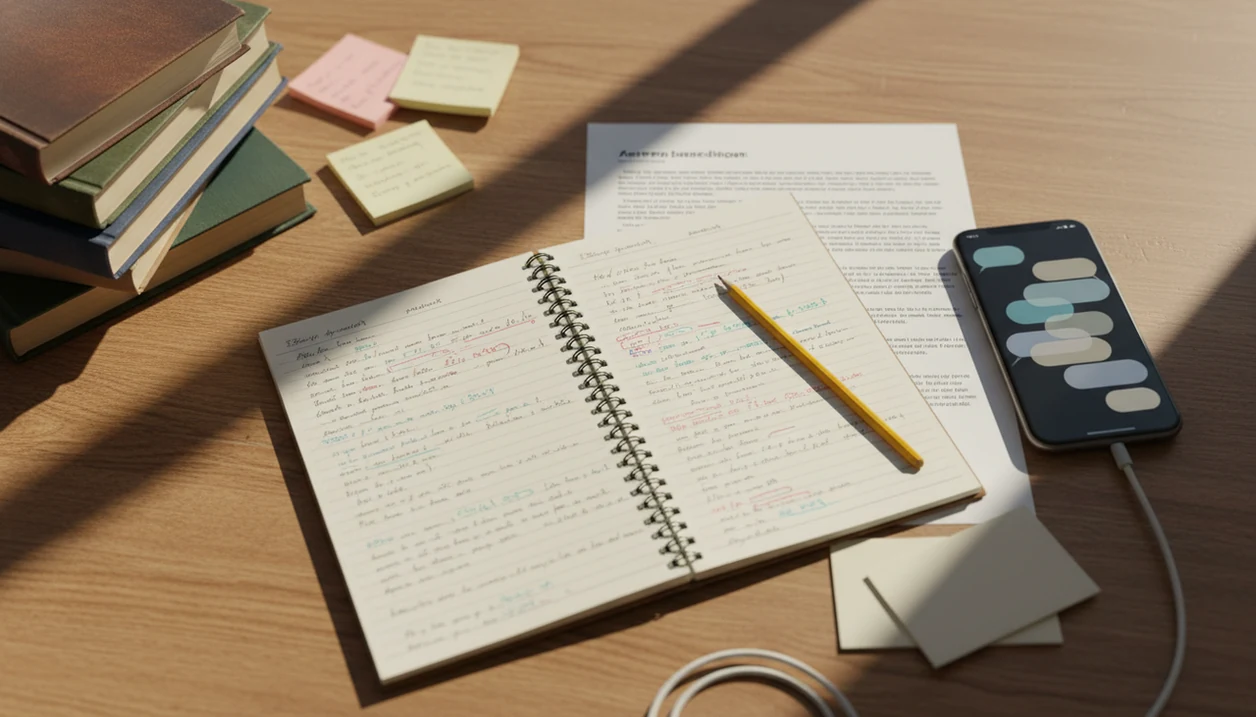
Student AI writing success stories usually come from students who use AI as a writing coach, not a ghostwriter: they brainstorm, outline, revise, fact-check, and polish while keeping ownership of the final work. The strongest outcomes are clearer structure, better revision habits, more confidence, and fewer blank-page moments without replacing original thinking.
> AI Chat is an AI chat app that combines chat, 200+ agents, AI detection, AI humanizing, and image generation for iPhone users.
- Responsible student AI writing works best when the student supplies the ideas, evidence, and final judgment.
- The most useful AI writing results for students come from repeatable workflows: notes to outline, draft to feedback, feedback to revision, and final self-audit.
- AI detection and humanizing tools can support reflection, but they cannot guarantee academic integrity or replace class policy.
Student AI Writing Success Stories: What Responsible Results Look Like
Student AI writing success stories are strongest when they show a better writing process, not an AI-written submission. A useful result looks like a student turning messy notes into a clearer outline, revising a weak paragraph, or learning how to explain an idea in their own words.
That distinction matters because AI use is already common in schoolwork. In a 2023 Pew Research Center survey, 51% of U.S. K–12 teachers said their students use AI-powered tools like ChatGPT for schoolwork, with many teachers concerned about guidance and oversight source.
The responsible pattern is simple. Follow the instructor’s rules, disclose AI use when required, verify sources, and remain the final author. A student at a library desk with a charger cord stretched across the floor still needs to decide what the paper actually argues.
Ownership stays with the student.
Student AI Writing Workflow Mechanics Behind the Scenes
Responsible AI writing support works because a language model predicts, reorganizes, summarizes, and reframes text based on the prompt and context it receives. In plain terms, it can help arrange words and options, but it does not understand your class unless you give it the right materials.
The practical workflow is iterative. The student enters notes, a rubric, a thesis, or a draft. AI suggests structure, clearer phrasing, missing transitions, or alternative explanations. Then the student evaluates those suggestions, checks facts, revises manually, and decides what belongs in the final version.
AI does not automatically know your teacher’s expectations, your lived experience, the quality of your sources, or the exact grading rubric. That is why pasting a rubric before asking for feedback often produces better guidance than asking, “Make this essay good.” The keyboard still covers half the paragraph on an iPhone, but the same rule applies: context first, output second.
5 Responsible Steps for Student AI Writing Results
Use AI for student writing by moving through a policy-first, student-owned workflow. The goal is to get feedback and options, not to outsource the assignment.
- Check class policy before using AI, including syllabus rules, assignment notes, and disclosure requirements.
- Start with your own notes, thesis, rubric, outline, source list, or rough draft.
- Ask AI for feedback, outline options, clarity improvements, or practice questions instead of a finished essay.
- Revise manually and verify every claim, quotation, citation, page number, and source summary.
- Run a self-audit using detection, humanization, and disclosure notes where appropriate.
For students, a repeatable AI writing workflow is often safer than one-off prompting because each step leaves room for judgment, correction, and teacher policy. If the assignment is homework rather than a paper, the same guardrails apply in a narrower form; our guide to how to use AI for homework on iPhone covers that difference.
Student AI Writing Results at a Glance
These stories show process wins, not guaranteed grade jumps. Each student uses AI for a bounded writing task, then keeps the final claim, evidence, wording, and submission decisions in human hands.
| Student | Assignment and AI use | Student-owned final output | Guardrail and main risk avoided |
|---|---|---|---|
| Maya | History essay outline built from her notes and sources | Thesis fit, quotation choices, topic sentences, and analysis | “Use only my materials” avoided invented facts and source drift |
| Jordan | Lab report revision feedback against a rubric | Methods edits, variable definitions, and conclusions tied to his data | Notebook verification avoided overstated results |
| Priya | English writing coach for prompt unpacking and paragraph feedback | Thesis choice, draft voice, and final sentence rewrites | Explain-it-out-loud rule avoided ghostwritten paragraphs |
Read the outcomes in order:
- Separate speed, structure, and confidence from grades.
- Treat AI suggestions as options, not authority.
- Keep evidence checking outside the generated response.
- Preserve a paper trail: prompt, draft, revision choices, and disclosure if required.
- Judge the final submission by whether the student can defend every sentence.
The useful result is not “AI made it better.” It is “the student revised with more direction and less guessing.”
Method Behind These Student Writing Workflow Examples
The stories below are anonymized composite examples, not unverifiable grade claims. They are built to show realistic student writing workflow examples based on responsible-use patterns.
- The examples measure process outcomes: better outlines, clearer drafts, stronger revision, improved study habits, and confidence.
- The students keep control of ideas, evidence, interpretation, and final wording.
- AI is used for brainstorming, structuring, editing, and reflection, not hidden authorship.
- Monash University guidance on writing with AI describes similar support roles and emphasizes that students remain responsible for integrity source.
- Grades still depend on effort, course policy, teacher feedback, assignment type, and source quality.
No vignette should be read as a promise. A polished paragraph can still have weak evidence. A cleaner outline can still miss the main question. That is the awkward part students notice after the first shiny draft fades.
Success Story 1: Maya Turns Rough Notes Into a Stronger History Essay Outline
Maya starts with class notes, a tentative thesis, and three primary sources for a history essay. She does not ask AI to write the paper. She asks for three possible outline structures based only on the notes she provides.
On her iPhone, between library time, class, and the commute home, she compares the outline options. One structure follows chronology. Another groups causes and effects. A third separates political, economic, and social evidence. Maya chooses the second because it fits her thesis, then writes the analysis herself.
Tools like ACI can fit this kind of mobile workflow because the student can move from chat to outline review without opening three Safari tabs. The ACI iPhone AI chat app with specialized agents, built-in AI detection, AI humanization, and image generation for everyday writing, school, and work tasks should deliver structured support and review signals, not permission to submit work the student did not author.
Maya’s responsible AI prompt
“Use only these notes and sources. Suggest three essay outlines for this thesis. Do not add facts. Mark any weak transitions or missing evidence.”
Maya’s final human revision
Maya writes the topic sentences, chooses quotations, and adds source context. AI helped sequence ideas, but her judgment shaped the argument.
Success Story 2: Jordan Uses AI Revision Feedback for a Clearer Lab Report
Jordan pastes his own lab report draft, the rubric, and teacher comments into ACI. He does not paste raw data for AI to reinterpret, and he does not ask for new conclusions.
The feedback flags unclear methods, passive wording, missing variable definitions, and inconsistent headings. Jordan checks each suggestion against his notebook before revising. When AI suggests a smoother conclusion, he rejects the part that sounds stronger than his actual results. The numbers stay the same.
That matters in science writing. AI can make a lab report sound confident while quietly blurring what was measured. Jordan uses built-in AI detection as a self-audit for overreliance, not as proof that the work is human-authored. For students who need a narrower review pass, an app that checks and rewrites essays should still be used with the same caution.
Jordan’s revision checklist
Jordan checks whether variables are defined, methods match the experiment, headings follow the rubric, citations are real, and conclusions stay within the data. Boring checklist. Useful checklist.
Success Story 3: Priya Builds Confidence With AI as a Writing Coach
Priya struggles with blank-page anxiety on English assignments. Her group chat is buzzing during revisions, the deadline is close, and the first sentence keeps getting deleted.
AI helps her unpack the prompt, compare thesis alternatives, ask for paragraph feedback, and get plain-language explanations of teacher comments. A 2024 Oregon State University study found that student creativity improved significantly when students received explicit instruction on using AI for creative writing, compared with original writing and unguided AI use source.
- Priya uses AI to restate the assignment question in simpler terms.
- She asks for three thesis angles, then rejects the generic one.
- She writes the first draft herself before asking for paragraph feedback.
- She compares AI wording against her own voice.
- She rewrites final sentences manually so they sound like her.
Priya’s coach-not-ghostwriter rule
Priya never submits a paragraph she could not explain out loud. For anxious writers, AI feedback usually works best when it lowers the starting friction while preserving the student’s own decisions.
5 Common Patterns in Responsible AI Writing Results for Students
Responsible AI writing results for students tend to repeat the same five patterns. They work because the student keeps supplying the substance.
- Student-owned inputs: The student starts with notes, drafts, rubrics, source excerpts, or teacher comments.
- Narrow prompts: The request asks for one job, such as “find weak transitions,” not “write my paper.”
- Iterative revision: The student checks, rewrites, compares, and asks a second question.
- Source verification: Claims, quotations, citations, and summaries are checked outside the AI output.
- Final human editing: The student removes generic phrasing and restores their own voice.
AI is strongest for structure, clarity, alternatives, examples, and practice questions. It is weakest when asked to invent evidence, write the whole assignment, or replace teacher feedback. EDUCAUSE reported in 2023 that 98% of higher education faculty had at least some concern about academic integrity, while 51% also believed thoughtful AI integration could support learning source. That tension is the real classroom setting.
AI Chat Features That Support Student Writing Workflow Examples
ACI can support student writing workflows on iPhone through chat, specialized agents, AI detection, humanizing, and image generation. The useful framing is tool selection, not shortcut selection.
- Specialized writing agents: Students can use agents for outlining, revision, study questions, tone checks, and presentation planning.
- Built-in detector: Detection can help students notice over-assisted or formulaic passages, but it should not be treated as a verdict.
- Humanizer step: Humanizing can prompt students to reduce stiff wording, especially when a sentence sounds pasted-in.
- Image generation: Visual tools may help with class presentations, club flyers, or multimodal assignments when the teacher permits it.
A student writing a product description over lunch break faces different stakes than a student submitting an essay, but both need workflow boundaries. The ACI iphone ai chat app with specialized agents, built-in ai detection, ai humanization, and image generation for everyday writing, school, and work tasks is most useful when each feature supports a review step the user can explain.
Students comparing tool choices may also want a broader AI writing app for students breakdown.
Evidence Limits in Student AI Writing Success Stories
Individual student AI writing success stories do not prove guaranteed grade improvement. They show plausible workflow gains, such as clearer organization or more confident revision, but grades depend on course rules, teacher expectations, effort, assignment type, and source quality.
There is also a quieter risk. AI can make weak writing look smoother without improving the underlying analysis. A student may replace awkward sentences with cleaner ones and still fail to answer the prompt. Smoothness is not the same as understanding.
Some instructors prohibit AI use entirely. Others allow brainstorming but require disclosure. A few allow grammar help but not idea generation. The safest student workflow starts by reading the assignment policy before opening the tool. If the task is citation-heavy, students should treat style help separately from source evaluation; AI chat for APA style help can assist formatting, but it cannot confirm that a source belongs in the argument.
Limitations
AI writing tools can support student work, but the limitations are serious enough to name plainly.
- AI can produce factual errors, biased wording, and fabricated citations.
- AI detection tools can return false positives and false negatives, so they should not be treated as definitive proof.
- Unguided AI use can flatten a student’s voice or encourage shallow revision.
- Some schools, teachers, or assignments prohibit AI assistance entirely.
- AI may improve sentence clarity while failing to improve evidence quality, original insight, or subject mastery.
- Students still need to disclose AI use when required and follow academic integrity policies.
- Mobile convenience can increase overuse if students skip reading, planning, and teacher feedback.
- Humanizing tools can reduce stiff phrasing, but they cannot make dishonest authorship acceptable.
- A confident answer can still be wrong, especially on niche course readings or local class requirements.
The pocket check is real. If the phone makes AI available during every stuck moment, students need a rule for when to pause and think first.
FAQ
Is AI writing cheating for students?
AI writing is cheating when it violates assignment rules, hides required disclosure, or replaces the student’s original work. It may be allowed for brainstorming, outlining, revision, or proofreading when the teacher permits it.
Can AI improve student writing?
AI can improve structure, clarity, revision habits, and confidence when students use it with guidance and judgment. It does not automatically improve analysis, evidence, or subject understanding.
How should students use AI for writing assignments?
Students should check policy, start with their own notes or draft, ask for feedback, revise manually, and verify sources. Disclosure notes should be added when the class requires them.
Can AI write my essay for me?
Students should not submit AI-written essays as their own work. AI is safer as a support tool for planning, feedback, editing, and study.
Do teachers allow AI writing tools?
Teacher policies vary by school, course, and assignment. Students should read the syllabus or ask before using AI on graded work.
Are AI detectors accurate for student writing?
AI detectors can flag possible AI use, but they are not definitive. False positives and false negatives can happen.
What is responsible AI use for school writing?
Responsible AI use is transparent, policy-compliant support for brainstorming, outlining, revision, editing, and study. The student remains the author and final decision-maker.